



A hotel guest does not experience a property as a collection of departments, systems, or software. They experience one continuous journey.
A reservation confirmation, a pre-arrival message, check-in, a service request, a dining recommendation, an issue with the room, and a post-stay follow-up may all be handled by different teams. To the guest, however, every interaction contributes to the same impression of the hotel.
That is why hotel guest journey mapping matters. Instead of optimizing booking, arrival, service, and post-stay engagement separately, hotels can map the full experience, identify where information is lost, and remove the moments that force guests to wait, search, or repeat themselves.
The goal is not to add more technology. It is to make every guest touchpoint feel connected.
What is Hotel Guest Journey Mapping?
Hotel guest journey mapping is the process of documenting how a guest interacts with a property from booking through post-stay, then identifying the needs, touchpoints, handoffs, and friction at each stage.
A useful journey map goes beyond a list of channels. It asks four practical questions:
- What is the guest trying to accomplish at this stage?
- Which hotel touchpoint helps them do it?
- Where can friction, repetition, or missed opportunities appear?
- Who owns the next action when the guest needs help?
That turns the journey map from a marketing diagram into an operational framework that teams can actually use.
A 6-Stage Connected Hotel Guest Journey Framework
For most properties, the journey can be mapped into six connected stages. The exact channels will vary, but the operational questions will remain consistent.
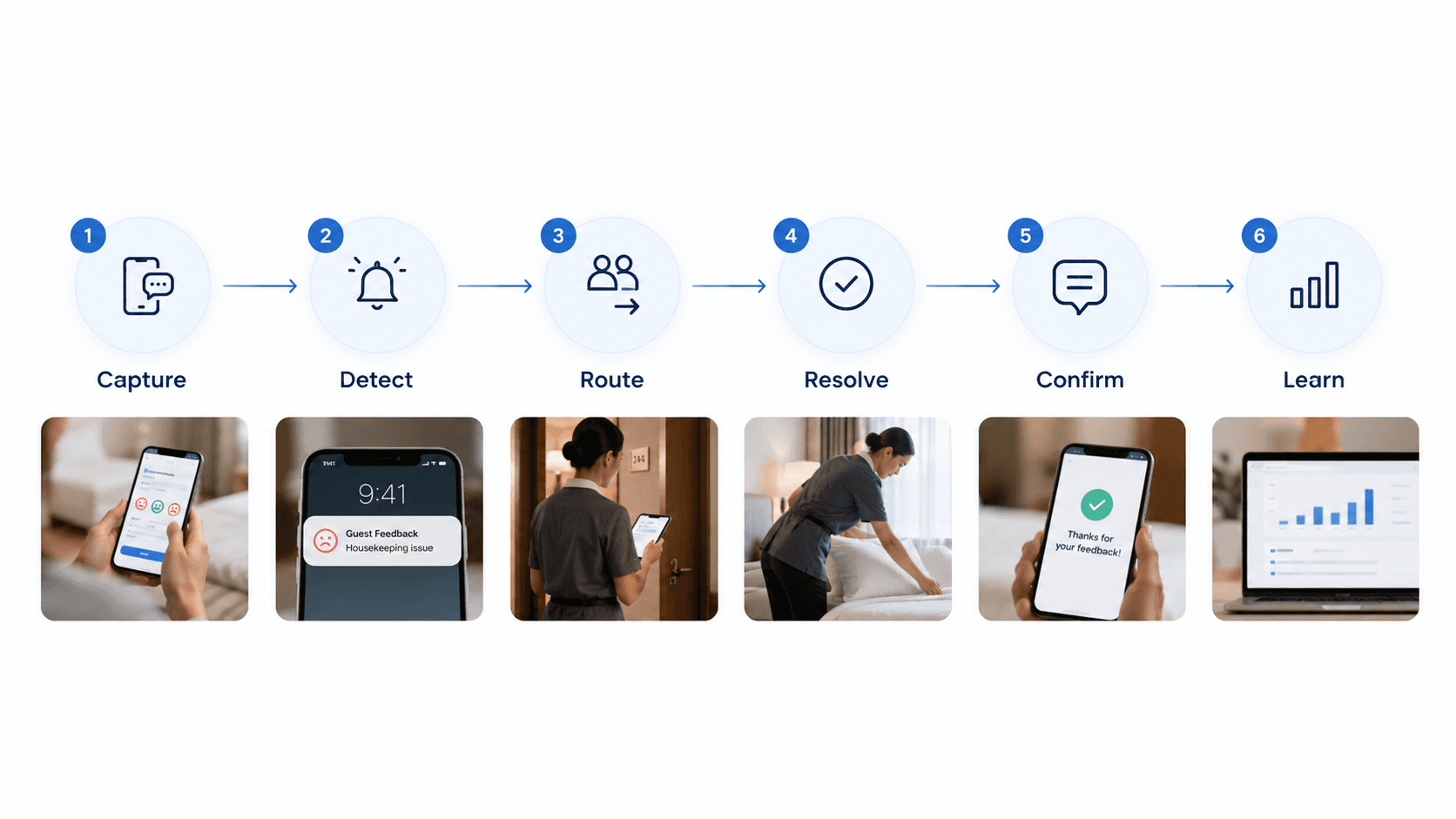
| Stage | Guest goal | High-value touchpoints | Key question for the hotel |
| 1. Book | Confidence and clarity | Confirmation, welcome message, mobile access | What does the guest need immediately after booking? |
| 2. Prepare | Plan and personalize | Pre-arrival offers, preferences, transport, FAQs | Can guests prepare without calling the hotel? |
| 3. Arrive | Fast, low-friction arrival | Mobile check-in, room readiness, front desk | Are we asking for information the guest already gave us? |
| 4. Stay | Easy access to service | Digital compendium, messaging, dining, amenities, requests | Can the guest get help without knowing our org chart? |
| 5. Depart | Smooth closure | Billing, late checkout, transport, in-stay feedback | Are unresolved issues visible before checkout? |
| 6. Continue | Recognition and relationship | Feedback, reviews, loyalty, future offers | What context should carry into the next stay? |
1. Booking: Set Up the Next Interaction Immediately
Once a reservation is confirmed, the traveler has moved from consideration to commitment. That is the first opportunity to create continuity.
A confirmation email is essential, but the better journey does more than restate dates and policies. It gives the guest a clear next step: access hotel information, ask a question, share a preference, or begin planning the stay.
This matters because a long communication gap between booking and arrival makes the pre-arrival experience feel disconnected. The journey should move naturally from “I booked” to “I know what happens next.”
2. Pre-Arrival: Turn Anticipation into Useful Engagement
Pre-arrival is one of the most valuable hotel guest touchpoints because guests are actively thinking about the upcoming stay. They may be considering transportation, room preferences, early check-in, dining, spa appointments, upgrades, or local experiences.
The mistake is waiting until the guest reaches the front desk to surface those options. A connected pre-arrival experience makes relevant services easy to discover while the guest is still planning.
For example, NexGen Guest’s Pre-Arrival Upsell flow connects the post-booking moment with mobile access to room upgrades, amenities, transportation, experiences, and hotel chat. The strongest use of pre-arrival engagement is not simply “sell more”; it is “help the guest prepare while relevant choices are top of mind.”
3. Arrival: Remove Repetition, Not Hospitality
Arrival is where disconnected systems become obvious. If a guest already shared their information or preferences online but must repeat everything at the front desk, the digital journey has not actually reduced friction.
The arrival experience should continue the conversation that began before the guest reached the property. Mobile check-in can handle routine steps while staff focus on exceptions, recognition, and higher-value personal interaction.
NexGen Guest’s Mobile Check-In is web-based and does not require guests to download an app. The product-design principle is simple: remove unnecessary waiting without removing the option for human service.
4. In-Stay: Make the Hotel Easy to Navigate
Once the guest is on property, the number of possible interactions increases quickly. Dining hours, housekeeping, maintenance, spa information, transportation, local recommendations, room service, amenities, and simple questions can all become separate journeys if the hotel is not careful.
Guests should not have to understand the hotel’s organizational structure to get something done. They need one easy path to information and one clear way to ask for help.
A Digital Compendium can centralize hotel information and services on the guest’s phone, while guest messaging provides continuity when the need requires a conversation or staff action.
5. Service Recovery: Move Feedback Earlier in the Journey
One of the largest gaps in the traditional hotel guest journey is discovering a problem after checkout. Post-stay surveys and online reviews are valuable for learning, but they cannot repair an experience that has already ended.
In-stay feedback changes the operational value of feedback. A concern can move through a simple service-recovery loop:
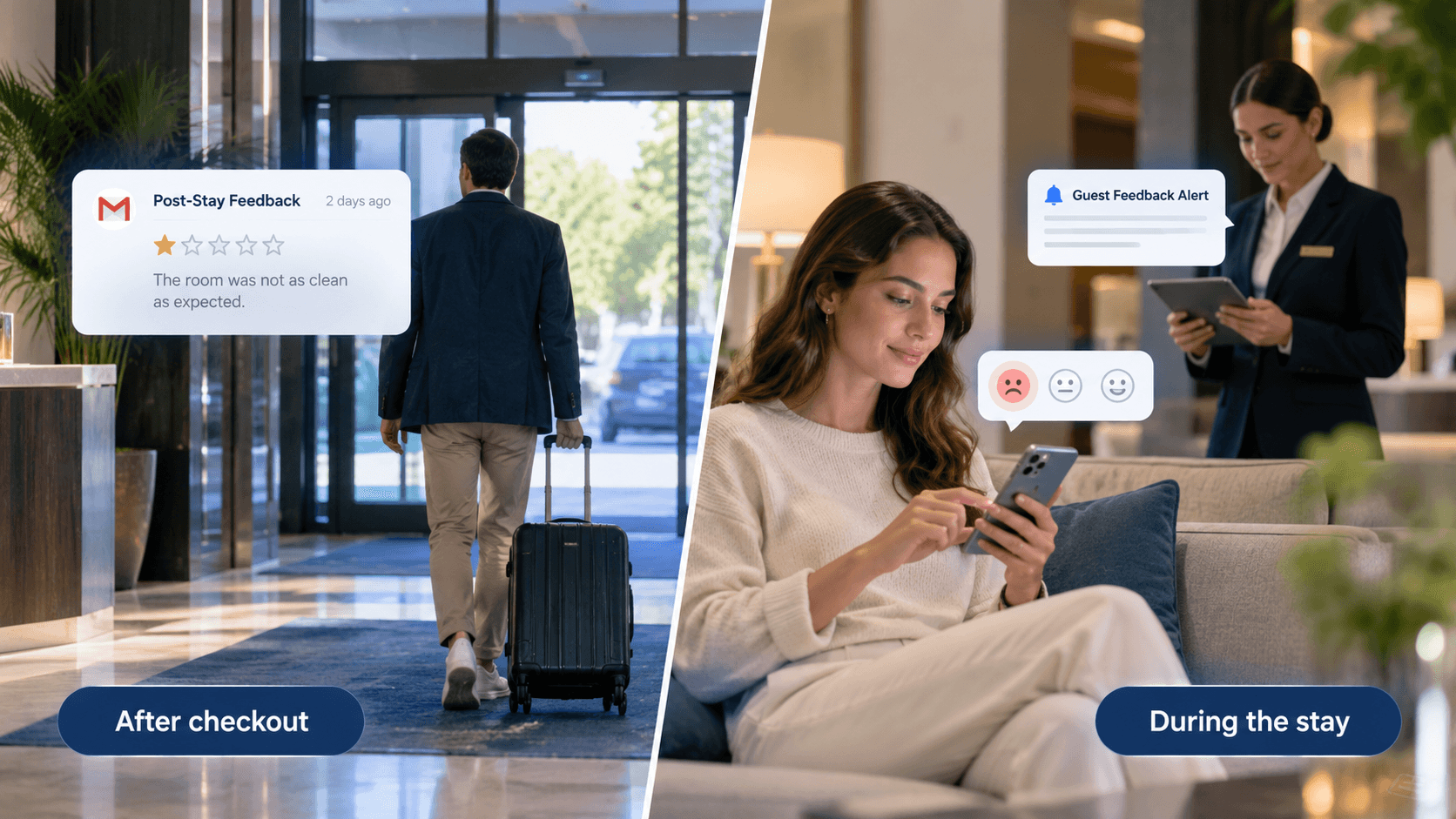
Guest concern -> Team awareness -> Department action -> Resolution
The important question is not only whether the hotel collects feedback. It is whether that feedback becomes visible early enough for someone to act on it.
This is the logic behind NexGen Guest’s Guest Feedback and Service Recovery case study, which focuses on identifying guest concerns during the stay instead of waiting for post-stay feedback.
6. Checkout and Post-Stay: Close the Loop Without Starting Over
Checkout should be mapped with the same care as arrival. Billing questions, late checkout, luggage storage, transportation, and unresolved service requests all influence the final impression of the stay.
The post-stay stage should then carry forward useful context rather than treating the guest like a new contact. Was an issue reported? Was it resolved? Which services did the guest use? Was a stay for business or leisure?
Relevant context makes follow-up more useful and creates a stronger foundation for loyalty, reviews, and future direct bookings. The goal is continuity, not simply more messages.
Where Hotel Guest Journeys Usually Break
Most hotels already have many of the individual pieces needed to deliver a strong experience. The problem is often the handoff between them.
- Reservation data sits in one system while pre-arrival communication is managed somewhere else.
- Front-desk teams cannot see preferences or requests collected before arrival.
- Guests receive information but do not have an easy path to request service.
- Feedback is collected, but ownership and follow-up are unclear.
- Revenue opportunities appear at isolated moments instead of across the full journey.
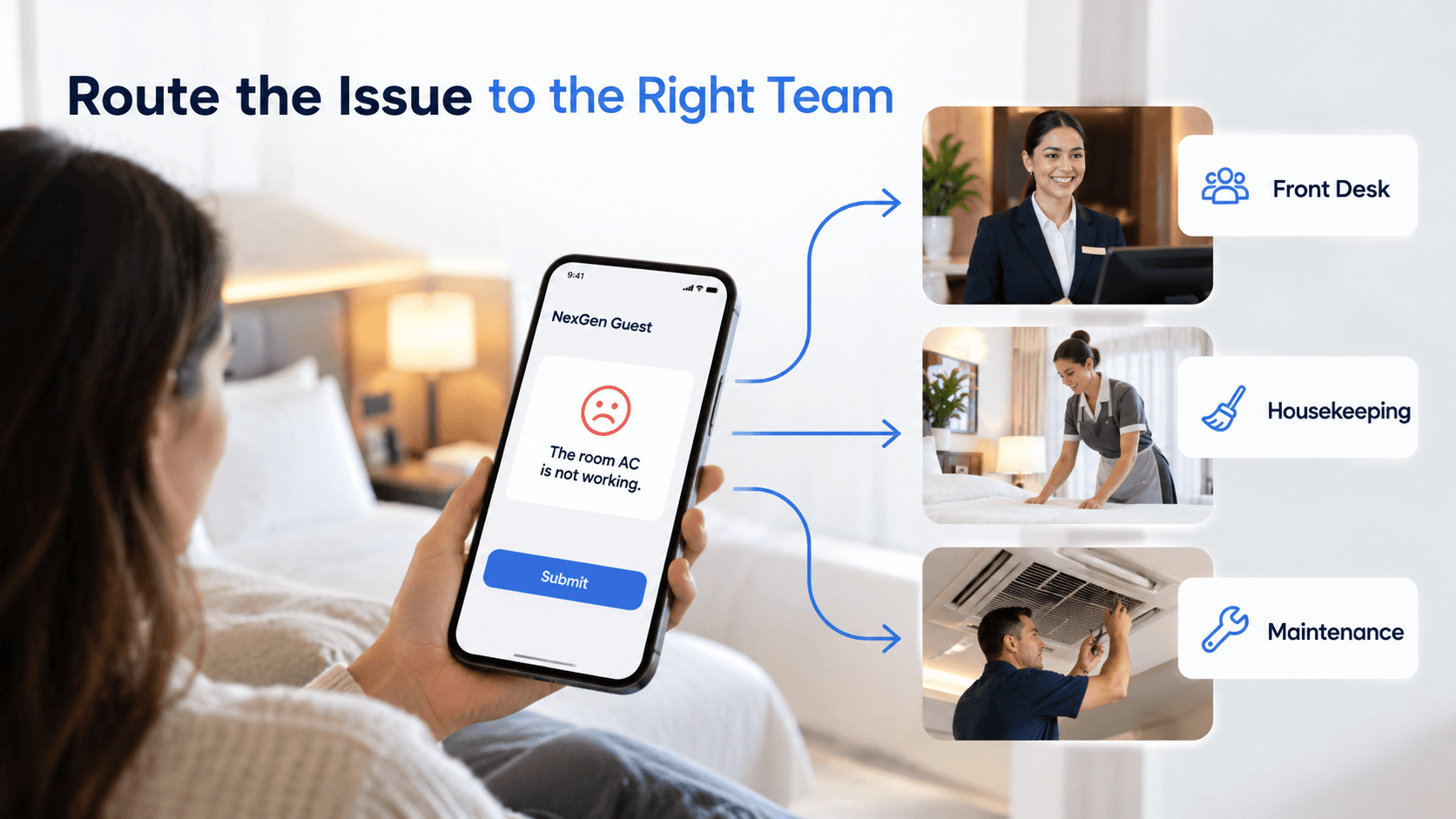
Individually, every team can do its job correctly while the overall experience still feels fragmented. Journey mapping exposes those handoffs and makes ownership visible.
How to Build a Hotel Guest Journey Map Teams Can Actually Use
1. Start with guest stages, not departments.
Map booking, pre-arrival, arrival, in-stay, departure, and post-stay from the guest’s point of view.
2. Document the real touchpoints.
Include emails, texts, mobile web, check-in, front desk interactions, QR codes, service requests, messaging, feedback, and post-stay communication.
3. Mark friction and repetition.
Look for waiting, repeated data entry, unclear ownership, dead ends, or moments where guests must switch channels unnecessarily.
4. Assign ownership to the next action.
Every request, issue, or opportunity should have a clear next step and responsible team.
5. Connect measurements to each stage.
Track the outcome that matters at that moment instead of treating every channel as an isolated dashboard.
What Should Hotels Measure Across the Guest Journey?
A journey map becomes more useful when each stage has a small set of meaningful measures. The point is not to build a larger dashboard; it is to understand whether the guest is moving through the journey with less friction and whether the hotel is capturing the operational or revenue value of that improvement.
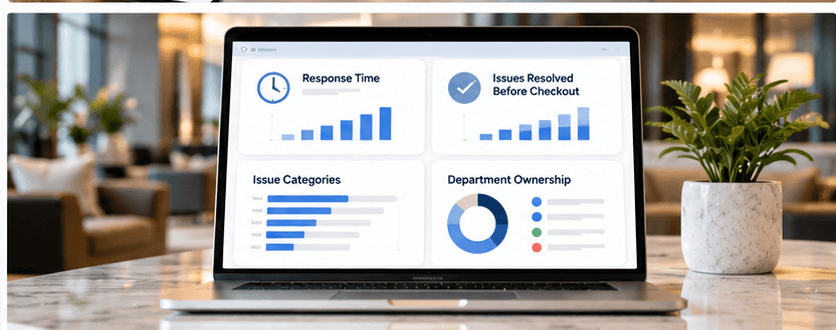
| Journey stage | Useful measures | What it tells you |
| Pre-arrival | Message engagement; offer conversion; preference completion | Whether guests are planning and engaging before arrival |
| Arrival | Mobile check-in completion; queue reduction; service time | Whether arrival friction is decreasing |
| In-stay | Content engagement; request completion; response time | Whether guests can find information and get help quickly |
| Service recovery | Issue visibility; ownership; resolution before checkout | Whether feedback is becoming action |
| Revenue | Offer engagement; conversion; ancillary revenue per guest | Whether relevant services are easier to discover |
| Post-stay | Feedback completion; reviews; repeat engagement | Whether the relationship continues after departure |
What Connected Touchpoints Can Change
The strongest reason to connect the guest journey is not cosmetic consistency. It is that connected touchpoints can influence both guest convenience and hotel performance.
In NexGen Guest’s hotel ancillary revenue case study, property connected pre-arrival offers, mobile service discovery, guest messaging, and on-property touchpoints. The published results include a 27% increase in ancillary revenue per guest, 23% engagement with digital offers, and a 19% conversion rate on selected pre-arrival offers.
The takeaway is not that every touchpoint should become a sales channel. It is that relevant services perform better when guests can discover them at the moment; they are useful.
Connect the Journey Without Adding More Friction
Hotel guest journey mapping should ultimately simplify the experience for guests and staff. Fewer disconnected interactions. Fewer repeated questions. Clearer ownership. Easier discovery of relevant services. Faster visibility when something goes wrong.
Technology supports that experience, but adding another isolated tool is not the objective. The better approach is to connect the moments that already exist for booking, pre-arrival engagement, check-in, hotel information, guest messaging, service requests, feedback, checkout, and post-stay follow-up.
When those touchpoints work together, the hotel gains a clearer view of guest needs while the guest gets a simpler way to interact with the property.
FAQs
What is a hotel guest journey?
The hotel guest journey is the sequence of interactions a guest has with a property across booking, pre-arrival, arrival, the stay, checkout, and post-stay communication.
What is hotel guest journey mapping?
Hotel guest journey mapping documents those stages and touchpoints so hotels can identify friction, clarify ownership, and improve the handoff between communication, service, operations, and revenue opportunities.
What are the most important hotel guest touchpoints?
Important touchpoints include booking confirmation, pre-arrival communication, mobile check-in, arrival, hotel information, guest messaging, service requests, in-stay feedback, checkout, and post-stay follow-up.
How can hotels improve the guest journey?
Hotels can improve the guest journey by reducing repeated steps, making information easier to access, connecting communication across stages, assigning clear ownership to requests, and acting on feedback while there is still time to improve the stay.