



A guest can have a problem with their room at 8 p.m., say nothing to the front desk, check out the next morning, and leave a negative review two days later.
At that point, the hotel can apologize. It can respond to the review. It may even offer the guest an incentive to return.
But the best opportunity to fix the experience has already passed.
That is why hotel guest feedback should not begin after checkout.
When hotels collect feedback while guests are still on property, they have something much more valuable than a satisfaction score: time to act.
A broken air conditioner can be repaired. A housekeeping concern can be corrected. A noisy room can be addressed. A delayed request can be escalated.
The goal is not simply to collect more feedback. The goal is to create a service recovery process that helps the hotel identify problems, respond quickly, and confirm that they were resolved before the guest leaves.
Why Post-Stay Feedback often Comes Too Late

Post-stay surveys have an important role. They help hotels understand overall satisfaction, identify long-term trends, and learn how guests viewed the complete stay.
But they have one major limitation.
The stay is already over.
If a guest reports poor room cleanliness in a survey sent the day after checkout, the hotel can learn from the issue. It cannot improve that guest's stay.
In-stay guest feedback changes the timing.
Instead of asking:
“How was your stay?”
after the guest has left, the hotel can ask:
“How is your stay going?”
while something can still be done about the answer.
This shifts hotel guest feedback from a reporting exercise into an operational tool.
What is Hotel Service Recovery?
Hotel service recovery is the process of identifying a service failure and taking action to restore the guest experience.
A service failure does not have to be dramatic.
It could be:
- A room that was not cleaned as expected
- Slow delivery of requested towels
- Excessive noise
- Wi-Fi problems
- A maintenance issue
- A missed housekeeping request
- Poor service at an outlet
- Confusion around an amenity
- An unresolved front desk request
The important question is not whether hotels can eliminate every service problem.
They cannot.
The better question is:
How quickly can the hotel identify the problem, get it to the right person, resolve it, and confirm that the guest is satisfied?
That is the foundation of effective service recovery.
The Hotel Guest Feedback Service Recovery Playbook
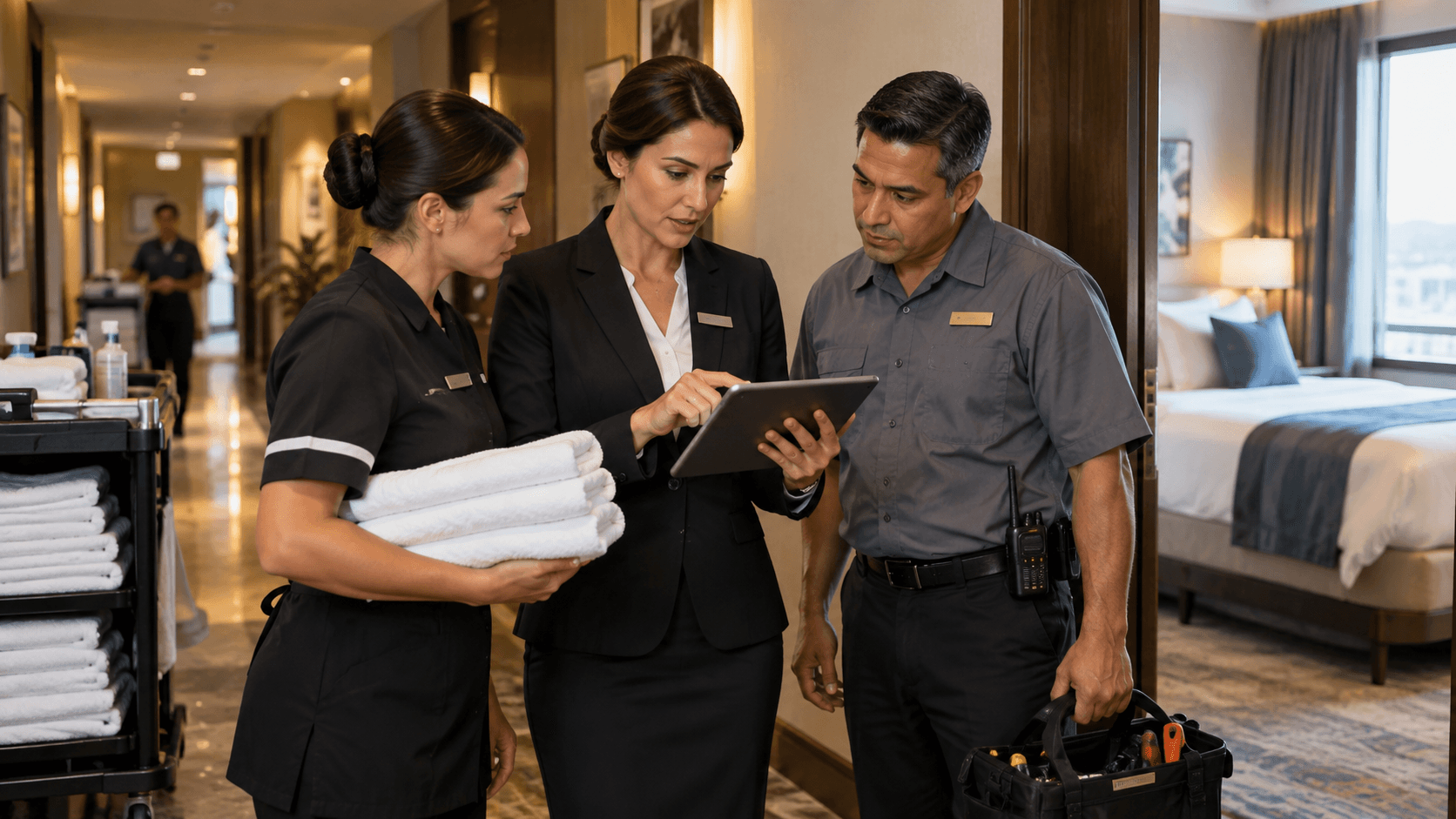
A useful service recovery process can be broken into five stages:
Detect → Route → Resolve → Confirm → Learn
1. Detect the Problem While the Guest Is Still on Property
Hotels cannot fix problems they do not know about.
The first step is creating a simple way for guests to share feedback during their stay.
Feedback requests should be:
- Short
- Mobile-friendly
- Easy to understand
- Sent at relevant moments
- Focused on issues the hotel can address
Guests should not have to complete a long survey just to tell the hotel that their room is too warm.
A simple question such as:
“How is your stay going?”
can be enough to identify a problem.
Follow-up questions can then capture the area involved, such as room condition, housekeeping, facilities, food and beverage, or general service.
The easier the process is, the easier it becomes for the hotel to hear about issues before checkout.
2. Route the Feedback to the Right Team
Collecting hotel guest feedback is only useful when someone acts on it.
A common service recovery failure happens when a guest reports an issue, but the information remains inside a survey dashboard or inbox.
That creates another problem: the hotel knows something is wrong, but the team responsible for fixing it does not.
Feedback should therefore lead to clear operational ownership.
For example:
| Guest Issue | Likely Owner | First Action |
| Room cleanliness | Housekeeping | Inspect and correct the room |
| Air conditioning | Engineering | Check the unit |
| Noise complaint | Front Office / Security | Investigate the source |
| Missing room item | Housekeeping | Deliver the item |
| Facility problem | Engineering | Inspect and repair |
| Service concern | Department Manager | Review and contact guest |
Every issue should have an owner.
Without ownership, feedback becomes data rather than action.
3. Resolve the Issue Quickly
Speed matters during service recovery.
A guest who reports a problem has already experienced inconvenience. Long delays increase frustration.
Hotels should define response expectations based on the type and severity of the issue.
A simple framework can be:
High priority: Safety, security, room access, major room failures
Medium priority: Cleanliness, maintenance, noise, delayed requests
Lower priority: Suggestions, preferences, minor service observations
This helps teams focus on the problems that require immediate attention without treating every piece of feedback in the same way.
Hotels should also empower staff to solve common problems without unnecessary approval of layers.
A recovery workflow loses value if a department receives an alert immediately but must wait an hour for permission to act.
4. Confirm That the Problem Was Actually Fixed

This is the step that many service recovery processes are missing.
Completing a task internally does not always mean the guest believes the issue has been resolved.
Imagine a guest reporting that the room is too warm.
Engineering visits the room, adjusts the system, and closes the maintenance request.
Operationally, the task is finished.
But what if the room is still uncomfortable?
Service recovery should include a final confirmation.
That can be as simple as asking:
“Is everything working properly now?”
Closing the loop does two things.
First, it confirms the actual guest outcome.
Second, it shows the guest that the hotel did not simply process the complaint and move on.
The difference between task completion and guest recovery matters.
5. Learn From Repeated Feedback
Not every problem should remain in an individual incident.
If five guests report the same issue within a week, management may be looking at an operational pattern rather than five unrelated complaints.
Hotels should review hotel guest feedback by categories such as:
- Department
- Issue type
- Location
- Time of day
- Room type
- Frequency
- Resolution time
- Repeat occurrence
For example, repeated feedback about rooms not being ready may indicate an arrival or housekeeping workflow problem.
Repeated Wi-Fi complaints on one floor could indicate an infrastructure issue.
Multiple complaints about response delays during a certain period may point to staffing or process gaps.
Real-time feedback solves today's problem.
Feedback analysis helps prevent tomorrow's problem.
In-Stay Feedback vs. Post-Stay Feedback
Hotels do not need to choose one or the other.
They serve different purposes.
| In-Stay Feedback | Post-Stay Feedback |
| Collected while guest is on property | Collected after departure |
| Designed for immediate action | Designed for overall evaluation |
| Supports service recovery | Supports trend analysis |
| Helps resolve current issues | Helps improve future stays |
| Operational focus | Experience and reputation focus |
A strong hotel feedback strategy can be used for both.
In-stay feedback helps save the current experience.
Post-stay feedback helps evaluate the complete experience.
What Should Hotels Measure?
A hotel guest feedback program should measure more than survey participation.
For service recovery, some of the most useful KPIs are:
Feedback participation rate
How many guests provide in-stay feedback?
Negative feedback rate
How often do guests report a problem?
Acknowledgment time
How long does it take for the hotel to recognize the issue?
Resolution time
How long does it take to correct the problem?
Recovery completion rate
What percentage of identified issues are resolved before checkout?
Guest confirmation rate
How often does the guest confirm that the issue has been resolved?
Recurring issue rate
Which problems continue to appear?
These measurements move the discussion beyond:
“Are guests happy?”
toward:
“Where are problems happening, how quickly are we fixing them, and are they happening again?”
How Technology Supports Hotel Service Recovery
Technology should make service recovery simpler, not adding another dashboard for staff to monitor.
An effective hotel guest feedback system should help hotels capture feedback at the right time, identify negative experiences, make the information easy for hotel teams to understand, and support quick action.
NexGen Guest's On-Property Guest Feedback solution is designed around this in-stay approach. Guests can share feedback while they are still at the property, giving teams an opportunity to respond before the stay is over.
The value is not simply collecting another survey.
It is shortening the distance between:
Guest experiences problem → Hotel knows about problem → Team takes action → Guest confirms resolution.
When that cycle becomes faster, service recovery becomes part of daily hotel operations rather than something that happens after a poor review appears.
A Simple Service Recovery Workflow Hotels Can Adopt
Hotels do not need an overly complex process.
Start with five questions:
- How will we ask guests for feedback during their stay?
- Who receives feedback when something is wrong?
- Who owns each type of issue?
- How quickly should the issue be resolved?
- How will we confirm that the guest is satisfied before checkout?
Then review the data regularly.
Look for common issues.
Look for slow departments.
Look for problems that keep returning.
And recognize teams when guests consistently highlight excellent service.
The purpose of feedback is not only to find faults.
It should also show management what the hotel is doing well.
Turn Feedback into a Chance to Recover the Stay
A negative guest experience does not always have to become a negative post-stay review.
The hotel still has an opportunity while the guest is on property.
The challenge is knowing there is a problem soon enough to act.
By collecting hotel guest feedback during the stay, routing problems to the correct teams, resolving them quickly, and confirming the outcome before checkout, hotels can turn feedback into a practical service recovery system.
Instead of learning what went wrong after the guest leaves, hotels can respond when the experience can still be changed.
That is where real-time feedback becomes valuable.
Want to see how NexGen Guest helps hotels capture and act on feedback while guests are still on property? Explore On-Property Guest Feedback.
FAQs
What is hotel guest feedback?
Hotel guest feedback is information guests provide about their experience with a hotel, including comments about rooms, facilities, housekeeping, service, amenities, and overall satisfaction. Feedback can be collected during or after the stay.
Why should hotels collect feedback before checkout?
Collecting feedback before checkout gives hotel teams time to identify and resolve problems while the guest is still on property. Post-stay feedback remains useful for analysis, but it cannot change an experience that has already ended.
What is service recovery in a hotel?
Hotel service recovery is the process of responding to a service failure, resolving the problem, and rebuilding guest satisfaction. Effective recovery includes identifying the issue, assigning ownership, fixing it, and confirming the outcome with the guest.
What is an in-stay guest feedback system?
An in-stay guest feedback system allows hotels to collect guest opinions and concerns during the stay instead of waiting until departure. This helps hotel teams detect problems earlier and act before checkout.
How can hotels use guest feedback to improve operations?
Hotels can group feedback by department, issue type, location, time, and frequency. Repeated problems can reveal operational gaps that management can address through process changes, maintenance, training, or staffing decisions.