


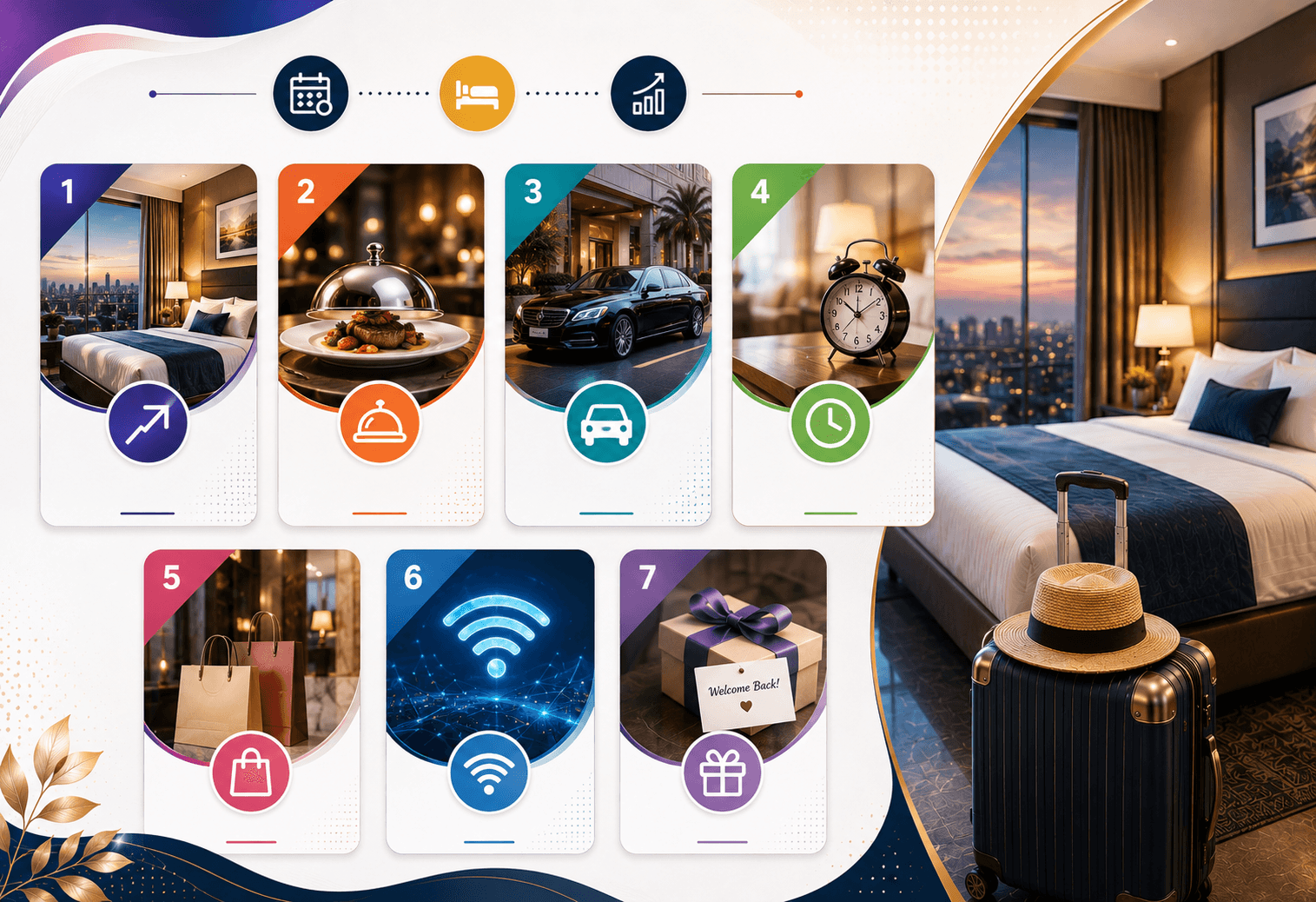
Between booking and checkout, hotels have multiple revenue opportunities beyond the room from upgrades and early check-in to dining, spa services, local experiences, and late checkout.
From the time guests make a reservation to the moment they check out, they continue making decisions about their stay. They may want a better room, an earlier arrival, dinner reservations, a spa appointment, airport transportation, activities nearby, or a few extra hours before departure.
Hotels often provide all these services already. The missed opportunity is that guests do not always discover them at the right time.
Traditionally, hotels have relied heavily on the front desk to introduce upgrades and additional services. That still has value, but by check-in, many guest decisions have already been made. Transportation may already be booked. Dinner plans may be set up. Spa appointments may be unavailable. The guest may have found an off-property option simply because it was easier to discover.
A more effective approach is to look at the entire guest journey and identify where additional services genuinely fit.
Here are seven revenue opportunities that are often underused between booking and checkout.
1. Room Upgrades After Booking
The period immediately after booking is one of the most natural times to present a room upgrade.
At this stage, the guest has already committed the trip. They are starting to think about what the stay will feel like, which makes upgrades easier to consider in context.
A guest who booked a standard room may be interested in:
- an ocean or city view
- a larger room
- a balcony
- a suite
- a preferred floor
- connecting rooms
- additional amenities
- a celebration package
Waiting until check-in to offer these options can limit the opportunity.
The preferred room may no longer be available; the front desk may be managing a queue, or the guest may simply want to collect their key and get settled.
Pre-arrival upselling gives guests time to look at the option privately and decide whether the additional value makes sense for them.
The presentation also matters.
“Upgrading your room for $50” is less compelling than explaining what the guest gets for that $50.
For example:
Upgrade to an Ocean View Room $45 per night
Enjoy a private balcony and an unobstructed ocean view throughout your stay.
That feels less like a sales prompt and more like a useful choice.
Hotels should track which room categories receive the most interest, which guest segments convert, and how far ahead of arrival guests tend to accept an upgrade. Over time, this can make the upgrade strategy much more precise.
2. Early Check-In and Arrival Services
Arrival is another point where convenience has real value.
Consider a guest whose flight lands at 8 a.m. Their standard check-in may not be until 3 p.m. If the property has availability and housekeeping can support it, a paid early check-in may be worth far more to that guest than another promotional offer.
The same applies to other arrival-related services.
Hotels can use the pre-arrival period to make guests aware of:
- early check-in
- airport transfers
- valet or parking
- luggage arrangements
- welcome amenities
- flowers or champagne
- grocery packages
- birthday or anniversary setups
These are not necessarily new revenue streams. Most hotels already offer at least some of them.
The issue is timing.
An airport transfer offer has little value after the guest has already booked transportation. A welcome package cannot influence the experience if the guest learns about it after arriving.
This is why pre-arrival communication can be effective. It places relevant services in front of the guest while they are actively planning the trip.
For hotels using a platform such as NexGen Guest, these offers can be introduced through the pre-arrival mobile journey rather than relying entirely on staff to make the offer at check-in.
3. Food and Beverage That Guests Can Actually Find
Hotels invest heavily in restaurants, bars, room service, poolside dining, and other F&B experiences.
Yet guests still leave the property to eat somewhere else.
Sometimes that is exactly what they want to do. But in other cases, the hotel loses the business simply because its own options were harder to find.
Think about what happens when a guest enters their room and asks:
“Where should we eat tonight?”
Their first move may be Google Maps, a delivery app, or a search for restaurants nearby.
If the hotel wants its own dining options to be considered, they need to be just as easy to discover.
That could mean making it simple for guests to:
- view restaurant menus
- check operating hours
- reserve a table
- order room service
- order by the pool
- add breakfast
- browse bar menus
- see dietary information
- purchase a dining package
The same principle applies before arrival.
A guest who can reserve dinner while planning the stay may be more likely to dine on property than someone who first learns about the restaurant after checking in.
Mobile ordering can also extend the reach of F&B beyond the restaurant itself. A QR code or digital guest experience can turn the pool, cabana, lobby or spa area into another point where guests can browse and order.
The goal is not to bombard guests with food offers. It is simply to make the hotel's own options easy to access when the guest is already thinking about eating or drinking.
4. Spa, Wellness and Hotel Experiences
Some hotel services are difficult to sell at the last minute.
Spa treatments are a good example.
A guest may be interested in a massage, but if they only discover the spa after arriving and the best appointment times are gone, the hotel has missed the opportunity.
The same applies to:
- cabanas
- golf
- yoga sessions
- fitness classes
- private dining
- wine tastings
- children's activities
- equipment rentals
- tours
- cooking classes
- resort experiences
The more planning a service requires, the earlier it should become visible.
There is also an important difference between simply listing an amenity and giving the guest something they can do.
“Our hotel has a spa” is information.
“Massage appointments are available tomorrow afternoon” creates a decision.
Hotels can also become more selective about who sees which offers.
A family traveling with children may respond to completely different experiences than a couple on a weekend break. A business traveler staying for one night will probably have different priorities from a resort guest staying for a week.
That does not require complicated personalization from day one. Even basic segmentation based on stay type, length of stay or available services can make offers feel more relevant.
5. Transportation and Local Experiences
Not every revenue opportunity needs to stay inside the hotel.
Guests spend significant amounts of money outside the property on transportation, restaurants, tours, attractions, and entertainment.
Hotels have traditionally played an important role in recommending these experiences. Digital guest journeys create an opportunity to make those recommendations easier to act on.
A property might help guests discover:
- airport transfers
- local restaurants
- guided tours
- attraction tickets
- boat trips
- golf
- museums
- family activities
- events
- outdoor experiences
Where appropriate, hotels may also have commercial relationships with local businesses that create referral or commission opportunities.
But even without direct revenue, there is value in keeping the hotel involved in local discovery.
Imagine a guest looking for restaurants nearby.
Instead of leaving the hotel environment entirely, they could see a curated local guide containing nearby restaurants alongside the hotel's own dining options, opening hours and reservation links.
That provides a better service while also giving the property's own venues a fair opportunity to be considered.
This is the thinking behind geo-sensitive local guides: help guests explore what is around them without losing the hotel itself from the conversation.
6. Guest Questions That Reveal Purchase Intent
Some revenue opportunities arrive disguised as ordinary service questions.
A guest asks:
“Is early check-in available?”
“Do you have an airport shuttle?”
“Can we stay until 2 p.m.?”
“Is the spa open tomorrow?”
“Do you have a room with a better view?”
“Where can we get dinner?”
Each question tells the hotel something about what the guest wants.
The challenge is recognizing when a service response can also include a useful next step.
If a guest asks whether the spa is open, answering “Yes, until 8 p.m.” solves the immediate question.
But if appointments are available, a more helpful response might be:
“Yes, the spa is open until 8 p.m. There are still appointments available this afternoon if you'd like to see the treatment menu.”
That does not feel like aggressive upselling. It simply helps the guest complete what they were already trying to do.
The same thinking can apply across guest messaging.
Questions about dinner can lead to restaurant availability. Questions about transportation can lead to airport transfer. Questions about checkout can surface a late-checkout option.
The important point is relevance.
Hotels should not turn every conversation into a sales interaction. But when the guest has already expressed an intention, making the relevant service easy to access can improve both the experience and the commercial outcome.
7. Late Checkout and the Last Few Hours of the Stay
Hotels often stop thinking about additional revenue once the guest reaches checkout day.
There can still be useful opportunities.
A late checkout is one of the clearest examples.
A guest with a 7 p.m. flight may happily pay to keep the room until mid-afternoon. For them, the value is not the room itself—it is avoiding several inconvenient hours between checkout and departure.
When occupancy and housekeeping schedules allow it, hotels can offer options such as:
Checkout at 1 p.m. — $30
or
Keep your room until 3 p.m. — $55
Other departure-stage services may include:
- airport transfers
- extended parking
- luggage storage
- takeaway meals
- spa access
- day-use facilities
- return-stay offers
The important caveat is operational capacity.
An upsell is only worthwhile when the property can fulfil it without creating problems elsewhere. Selling late checkout on a room needed immediately for the next arrival may generate revenue but cause avoidable pressure on housekeeping and front-desk teams.
The revenue strategy still has to work with hotel operations.
Why These Opportunities Are Easy to Miss
Most hotels do not have a shortage of things to sell.
They have a visibility problem.
Different opportunities often live in different places:
The PMS knows about the reservation.
The front desk knows about upgrades.
The restaurant manages dining.
The spa manages treatments.
The concierge handles local recommendations.
Marketing sends pre-arrival emails.
Housekeeping manages room readiness.
The guest, however, experiences one hotel.
When these services are fragmented, guests may never discover what is available—or may discover it only after the moment of purchase has passed.
The opportunity is therefore less about inventing new services and more about connecting existing ones to the right points in the guest journey.
Think in Guest Moments, Not Departments
A useful exercise is to map revenue opportunities against the questions guests are likely to have.
| Guest moment | What the guest is thinking | Relevant opportunity |
| After booking | Can we make the stay better? | Room upgrade, package |
| Before arrival | How are we getting there? | Transfer, parking, early check-in |
| Arrival | Can we make this easier? | Upgrade, welcome amenity |
| During stay | Where should we eat? | Restaurant, room service, mobile ordering |
| Guest conversation | Can the hotel help with this? | Relevant service or add-on |
| Departure | What do we do before our flight? | Late checkout, transfer, luggage storage |
Looking at the guest journeys this way also helps avoid irrelevant promotions.
Not everyone needs an airport transfer.
Not every guest wants a spa treatment.
Not everyone should receive the same upgrade.
The more closely an offer matches what the guest is already trying to do, the less it feels like an upsell.
What Hotels Should Measure
Ancillary revenue is useful, but the total number alone does not explain much.
Hotels should also look at where the revenue came from.
Useful measures include:
Ancillary revenue per guest
How much additional revenue is being generated beyond the room?
Offer conversion rate
Of the guests who saw an offer, how many purchased it?
Average ancillary transaction value
What is the typical value of an upgrade, dining purchase or add-on?
Revenue by guest journey stage
Are guests more responsive after booking, before arrival or during the stay?
Revenue by department
Which areas are driving incremental spending rooms, F&B, spa, activities or transportation?
Revenue by guest segment
Do couples, families, leisure travelers and business travelers respond differently?
These measurements help hotels move beyond simply putting more offers in front of guests.
The better question becomes:
Which service is useful to which guest is, and when are they most likely to want it?
Not Every Guest Payment Is Hotel Revenue
There is one distinction worth making, particularly as digital tipping becomes more common.
The gratuity paid to an employee is not the same as ancillary hotel revenue.
Digital tipping can improve convenience for guests, make staff recognition easier and provide hotels with clearer operational records, but those gratuities belong to employees rather than representing revenue from hotel products or services.
Keeping tipping separate from ancillary revenue also makes reporting more accurate.
Room upgrades, dining, spa treatments and late checkout show what the hotel is selling.
Digital gratuities show how guests are recognizing staff.
Both matter, but they measure different things.
The Bigger Opportunity
The strongest hotel revenue strategies are rarely about pushing more offers.
They are about making useful services easier to discover.
A guest arriving early should be able to see whether early check-in is available.
Someone planning dinner should be able to find the hotel restaurant before searching elsewhere.
A guest interested in the spa should not have to call three departments to find an appointment.
A traveler with an evening flight should know whether a late checkout is an option.
Hotels already have many of these services.
The opportunity lies in connecting them to the moments when guests actually need them.
That is where the period between booking and checkout becomes much more than an operational journey.
It becomes a series of opportunities to improve the stay while generating additional revenue from services the property already provides.
FAQs
What is hotel ancillary revenue?
Hotel ancillary revenue is income generated from products and services beyond the guest room in charge. This can include upgrades, food and beverage, early check-in, late checkout, spa treatments, parking, transportation, and paid experiences.
What are the best revenue opportunities after a hotel booking?
Common opportunities include room upgrades, early check-in, airport transportation, dining, spa treatments, experiences, and late checkout. Which opportunities perform best depends on the property, guest segment and timing.
When should a hotel send an upsell offer?
The timing should match the service. Room upgrades and arrival services often make sense before the stay, while dining, spa and activity offers may become more relevant closer to arrival or while the guest is on property.
How can hotels increase ancillary revenue without adding more staff?
Making existing services easier to discover and purchase can reduce dependence on manual front-desk upselling. Pre-arrival messaging, digital compendiums, mobile ordering, guest messaging and mobile check-in can all help guests access relevant services directly.
What is the difference between upselling and cross-selling in hotels?
Upselling encourages a guest to move to a higher-value version of something they have already purchased, such as upgrading from a standard room to a suite. Cross-selling introduces additional services, such as breakfast, parking, spa treatment, or airport transportation.
Does digital tipping count as hotel ancillary revenue?
Generally, no. Gratuities intended for hotel employees are staff earnings rather than revenue generated by the property. Hotels should track digital tipping separately from ancillary revenue.