

Hotels today are under pressure to deliver faster service, more personalized guest communication, and stronger revenue results without adding operational strain. At NexGen Guest, we see AI chatbots as more than a support tool. They are part of a connected guest journey strategy that helps hotels respond faster, reduce repetitive workload, and unlock more revenue opportunities across booking, pre-arrival, and in-stay touchpoints. That positioning closely reflects how NexGen Guest presents its platform: mobile-first, hospitality-focused, and built to improve both guest satisfaction and operational efficiency.
An AI chatbot for hotels can be one of the most effective tools in that strategy. When implemented well, it helps hotels respond instantly to guest questions, reduce front desk workload, improve conversion during the booking journey, and surface timely room upgrade offers without requiring a larger team.
Why Hotels Are Investing in AI Chatbots
Guest expectations have changed. Travelers want quick answers, seamless digital interactions, and personalized options before and during their stay.
Hotels, meanwhile, need technology that supports those expectations without increasing staffing at the same pace. NexGen Guest’s own messaging reflects this shift by emphasizing automated guest communication, pre-arrival upsells, multi-channel messaging, and a “Personal Butler 24/7” approach to guest support.
AI chatbots are quickly becoming a practical part of modern hotel operations rather than an optional experiment.
They help hotels create a more responsive guest experience while also supporting key commercial goals like direct bookings, ancillary revenue, and smoother service delivery.
The Real Revenue Gap: Missed Upgrade Opportunities
Most hotels already know upgrades can increase average booking value. The problem is consistency.
Guests often reveal upgrade intent in the questions they ask. They ask about better views, balconies, suite options, extra space, quiet rooms, breakfast packages, early check-in, late checkout, or premium amenities. Those are not just service questions. They are buying signals.
Without automation, those signals are easy to miss. Reservation teams are handling calls, emails, arrivals, and walk-ins all at once. Front desk teams are busiest when upgrading conversations matter most. As a result, the hotel loses upsell opportunities simply because the right offer is not delivered at the right time.
How an AI Chatbot for Hotels Increases Upgrade Bookings
A well-designed chatbot for hotel bookings does more than answer FAQs. It guides demand toward higher-value outcomes.

Capture guest intent in real time
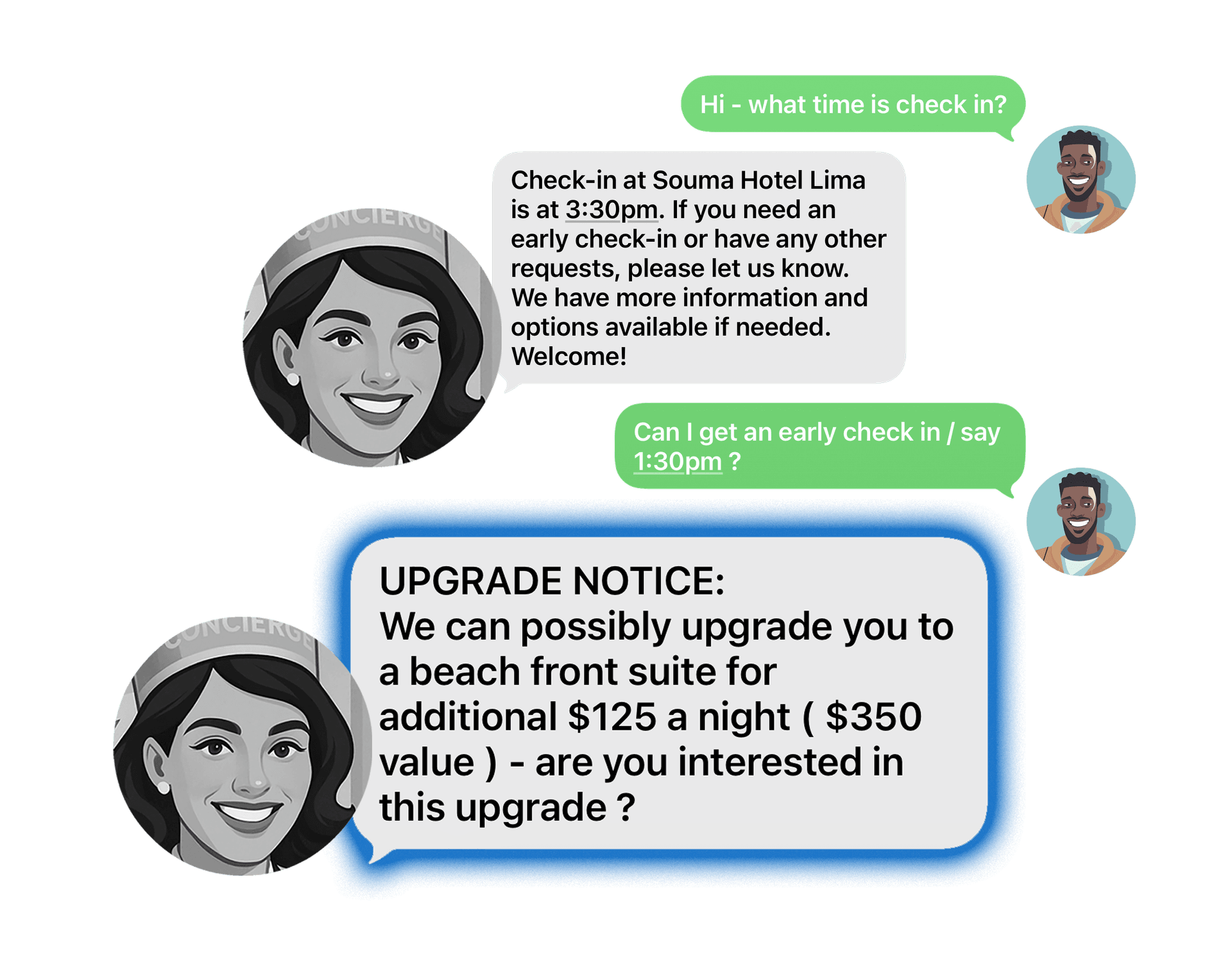
When a traveler asks whether a hotel has ocean-view rooms, connecting rooms, premium packages, or flexible check-in options, an AI chatbot can interpret that as purchase intent and present a relevant upgrade or add-on immediately. That is far more effective than sending a generic answer and hoping the guest asks again later. Hospitality AI vendors increasingly market this ability to turn conversations into booking and upsell opportunities.
Keep revenue opportunities open 24/7
Guests research and book outside business hours. A front desk team cannot answer every inquiry at midnight, but an AI chatbot can. That matters because delayed responses often mean lost bookings or lost upgrade opportunities.
Reduce repetitive workload for hotel staff
A large share of guest questions is repetitive: parking, breakfast, pet policy, check-in times, cancellation terms, room types, and local logistics. Automating those interactions lets staff focus on complex requests, high-value sales conversations, and in-person service. Current industry coverage and vendor pages both present this labor-efficiency benefit as one of the strongest reasons to adopt AI for hotel customer service.
Support pre-arrival and in-stay upselling
The most effective hotel upgrade automation does not begin at the front desk. It begins earlier, when guests are planning the trip or reviewing stay details. AI chatbots can promote room upgrades, early check-in, late checkout, breakfast packages, spa treatments, parking, or premium experiences before arrival and continue doing so during the stay. That supports both revenue growth and a smoother guest experience.
Improve conversion on direct channels
For hotels trying to reduce dependency on OTAs, that is a major strategic benefit of deploying an AI concierge for hotels on owned channels.
NexGen Guest highlights guest messaging and AI-powered communication to support direct revenue by answering questions quickly across channels like SMS, WhatsApp, web chat, and email. When guests get immediate answers on owned channels, they are more likely to continue booking directly instead of dropping off.
Why This Matters for Modern Hotel Operations
For hotel operators, AI chatbots are no longer just a service tool. They are becoming part of the commercial tech stack supporting direct bookings, reducing missed upsell opportunities, and helping teams handle more guest interactions without expanding operational overhead.
A modern AI chatbot for hotels helps solve several market realities at once. It supports instant digital service expectations, helps hotel teams handle more inquiries without more headcount, and creates a path to higher direct revenue through room upgrades and add-ons. Recent market coverage describes hotel chatbots in exactly those terms: revenue growth, better guest experience, and lower support burden.
This is also part of broader hotel digital transformation. The chatbot is no longer a standalone feature. It is increasingly part of a connected guest experience stack that includes mobile messaging, booking assistance, upselling, pre-arrival communication, and service automation. Current hospitality AI leaders are all moving in that direction.
What Hotels Should Automate First
Hotels do not need to automate everything at once. The best results usually come from focusing first on the questions and moments that combine high volume with high commercial value.
Start with booking questions, room-type comparisons, amenity requests, parking and pet-policy inquiries, pre-arrival messaging, and upgrade prompts tied to guest intent. These are exactly the use cases where AI can reduce staff burden while increasing conversion and ancillary revenue. Recent competitor content repeatedly emphasizes these booking-and-service moments as the best place for hotel AI to create a measurable impact.
What to Look for in an AI Chatbot for Hotels
Not every chatbot will help drive revenue. If the goal is better hotel revenue optimization, the platform needs to do more than answer basic questions.
The strongest solutions are hospitality-specific, support real booking journeys, work across channels, surface upgrade opportunities, and provide analytics that show how conversations affect bookings, handovers, and guest engagement.
Conclusion
If your hotel wants to increase upgrade bookings, you do not necessarily need to expand your front desk team. You need a system that answers faster, recognizes buying signals, and presents the right offer at the right moment.
That is exactly where an AI chatbot for hotels can create a measurable impact. It helps automate guest communication, improve hotel customer service, keep support available 24/7, and unlock more upgrade revenue without adding pressure to your staff. That is why the current market is moving toward AI-powered guest messaging, booking support, and upselling automation across the hotel journey.
Hotels that get this right do more than respond faster. They create a smoother guest journey, unlock more upgrade revenue, and give hotel teams more time to focus on hospitality where it matters most.
FAQs
What is an AI chatbot for hotels?
An AI chatbot for hotels is a digital assistant that helps answer guest questions, automate communication, support booking-related interactions, and surface relevant upsell opportunities across the guest journey. NexGen Guest’s Multi-Channel Guest Chat and chatbot case study both reflect this type of use case.
Can hotel chatbot automation increase upgrade bookings?
Yes. When a chatbot identifies booking intent and presents relevant room upgrades or add-ons before arrival or during booking, it can improve conversion and reduce missed upsell opportunities. NexGen Guest’s upsell-focused pages and case studies are built around that exact outcome.
How does AI help hotel customer service?
AI helps hotels provide faster answers, automate repetitive questions, and keep communication available around the clock. This reduces front desk pressure while improving guest responsiveness. NexGen Guest’s AI chatbot case study reports lower time spent on routine inquiries and higher guest engagement.
What is the best time to offer hotel upgrades?
Pre-arrival is one of the strongest moments because guests are engaged, still planning, and more open to personalized offers. NexGen Guest’s Pre-Arrival Upsell page and upsell case study both emphasize the value of presenting room upgrades and add-ons before check-in.
Does chatbot automation replace the front desk?
No. It handles repetitive and time-sensitive digital interactions, so hotel staff can focus on complex service, high-touch guest care, and in-person support. NexGen Guest’s AI chatbot case study supports this by showing routine inquiry handling time reduction rather than staff replacement.